
The recovery process following a dental implant takes place as bone cells envelop the implant and accept it as if it were a natural tooth root. So, is it really possible to speed up this process?
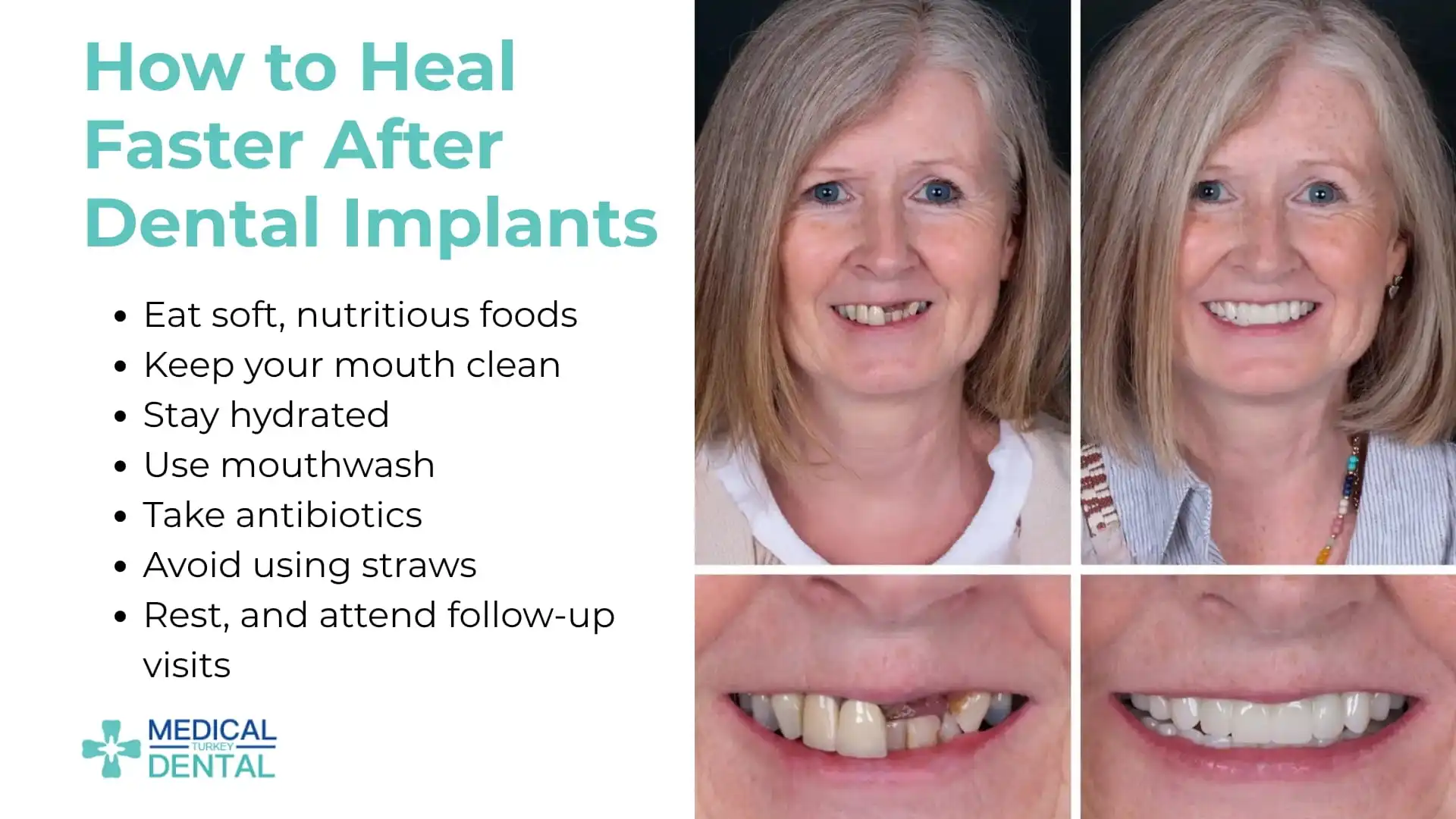
Yes, but the secret lies elsewhere: you cannot directly increase the rate of healing; you can only support it with the right care. Just as in a relay race, where the baton must be passed to the right person at the right moment, your body needs to receive the support it requires at each stage in good time. The first 48 hours are the most critical part of this process and require the greatest care.
So where does this support come from? The answer lies in a few simple habits: maintaining good oral and dental hygiene, avoiding smoking, eating soft foods in the first few days, not touching the implant site, and not missing your dental check-up appointments. In this article, we explain in detail, hour by hour and week by week, the steps that speed up healing and the mistakes you should avoid.
To learn more and discuss treatment options tailored to your needs, please continue reading and contact our expert team at Medical Dental Turkey.
How to heal faster after dental implants in Turkey?
Healing doesn't progress at a steady pace. Your body does its own work, but if you take the right steps, this process will be much faster and smoother. Just like a sapling takes root faster if you water it correctly, your implant will fuse more quickly with proper care.
First 24 hours
The implant surgery is over. Now your body will start sending you signals, and you will learn to read these signals correctly.
You can go home as soon as you feel ready. But first, know this: did you receive local anesthesia or sedation? This will determine your first few hours. If you had local anesthesia, you can drive, no problem. If you had sedation or general anesthesia, don't drive, the effects will wear off slowly like a foggy morning. Have someone drive you home.
If you see slight bleeding, there's no need to panic. This is your body saying "I'm starting to heal." Place a moist gauze pad on the implant area and gently bite down, that's enough. If bleeding worsens or doesn't stop, don't wait, call your dentist immediately.
Within 72 hours
Swelling and slight bruising are normal during this period, don't worry.
Apply ice immediately as soon as swelling begins. 10 minutes every hour is sufficient. Ice slows blood flow and helps stop the swelling from worsening. Use the mouthwash recommended by your dentist three or four times a day, and don't skip your antibiotic doses. Avoid hot food and drinks, as heat increases blood flow and delays healing.
First week
This week, your gums will begin to repair themselves, and you can return to your daily life.
If you have stitches, don't touch them; let them dissolve on their own or have your dentist remove them. Don't brush the area hard; clean it gently. Generally, you can return to your routine within a day, go to work, or go shopping. Just avoid strenuous exercise, as increased heart rate increases blood pressure in the implant area. This can both trigger bleeding and slow healing.
4-12 Weeks
During this period, you will not notice any visible changes, but a very important process is taking place inside your body: osseointegration. Although it may sound like a complicated term, it is actually very simple: your implant screw fuses with your jawbone.
You can't speed up this process, but you can slow it down. Smoking is your biggest enemy; it severely delays bone fusion. Don't miss your regular checkups; your doctor will be able to detect any potential problems early and take precautions. The calmer and more attentive you are during these 24-48 hours and beyond, the smoother the rest of your recovery will be.
When should you contact your dentist?
Please contact our Medical Dental Turkey dental clinic without delay in the following situations:
Mild discomfort is to be expected on the day of surgery, but a throbbing, persistent pain is a different matter. This is a sign that your body has exceeded the normal limits of recovery.
Numbness lasting longer than 12 hours also requires attention. The effects of anaesthesia usually wear off within a few hours, just like a mist clearing. If it persists, there may be pressure on a nerve.
Swelling or pain lasting more than 10 days is also outside the normal course of recovery. Swelling should subside during the first week, not increase. If something that should be subsiding is actually getting worse, this could be a sign of infection.
There is a clear rule regarding bleeding: bite down on a damp gauze pad and wait for 30 minutes. If the bleeding still does not stop, this is a sign that your body is unable to seal the wound on its own.
Finally, if the dental implant feels loose, do not delay. This is the clearest indication that there may be a problem with the osseointegration process.
Conclusion
Every patient recovers at a different pace. Some return to their normal routine within a week, whilst others need a little more time. The important thing is to interpret the signals your body is sending you correctly and, where necessary, to ask for help without hesitation.
If you have any concerns regarding your recovery process, please do not hesitate to contact our team of specialists at Medical Dental Turkey. We will listen to you, identify any potential issues early on and draw up a personalised plan for you. Contact us for a free consultation, and let us be by your side every step of the way during your dental implant process in Antalya.
Medically reviewed by A.Selhan Kaya
Published on